Pre-Game
Design Thinking Games
We live in a world that’s constantly changing. Designing for this change means opening our minds to new and sometimes unfamiliar ideas. So let’s start with a few simple games to warm us up for exploring different ways of approaching the designed world. Get ready to experience the “innovative mindset”!
This activity introduces an important practice for developing creative thinking known as Ideation, or generating lots of ideas. You may know it as Brainstorming. The goal here is to approach a challenge from as many angles as possible, without any judgment. That means there’s no right or wrong. Just have fun with it!
You’ll need the following materials:
- Paper
- Writing utensil
Steps:
- Begin by thinking of a random word—any word. Write the word down on paper.

- Flip the paper over and “write” the same word without using your writing utensil.
Yes, you read that right.
- How can you communicate your word without writing it down? In other words, how else can you use paper to express your word?
For example, Ronnie “writes” the word Airplane by folding his paper into an airplane shape.

- Once you’ve “written” your word in a new way, eliminate that option and try to think up another way to “write” your word without writing.
Ronnie eliminates the idea of folding his paper to communicate “airplane” and comes up with a new way to “write” his word: he rips a sheet of paper into the shape of an airplane.

- After finding a second way to write your word, eliminate that option and try to think of a third way to communicate the word.
- Keep at it for as long as you can. You can even get rid of the paper altogether. Again: there is no right or wrong! Let your imagination lead you.
Challenging ourselves with this kind of ideation helps us open our minds and think more creatively, leading to ideas we might not have discovered otherwise.
This game has been played by thousands of people, from kindergartners to top managers of world leading companies. Like the Paper Game, the Marshmallow Challenge encourages Ideation, opening your mind to new ideas and perspectives. It will also help you work together as a team.
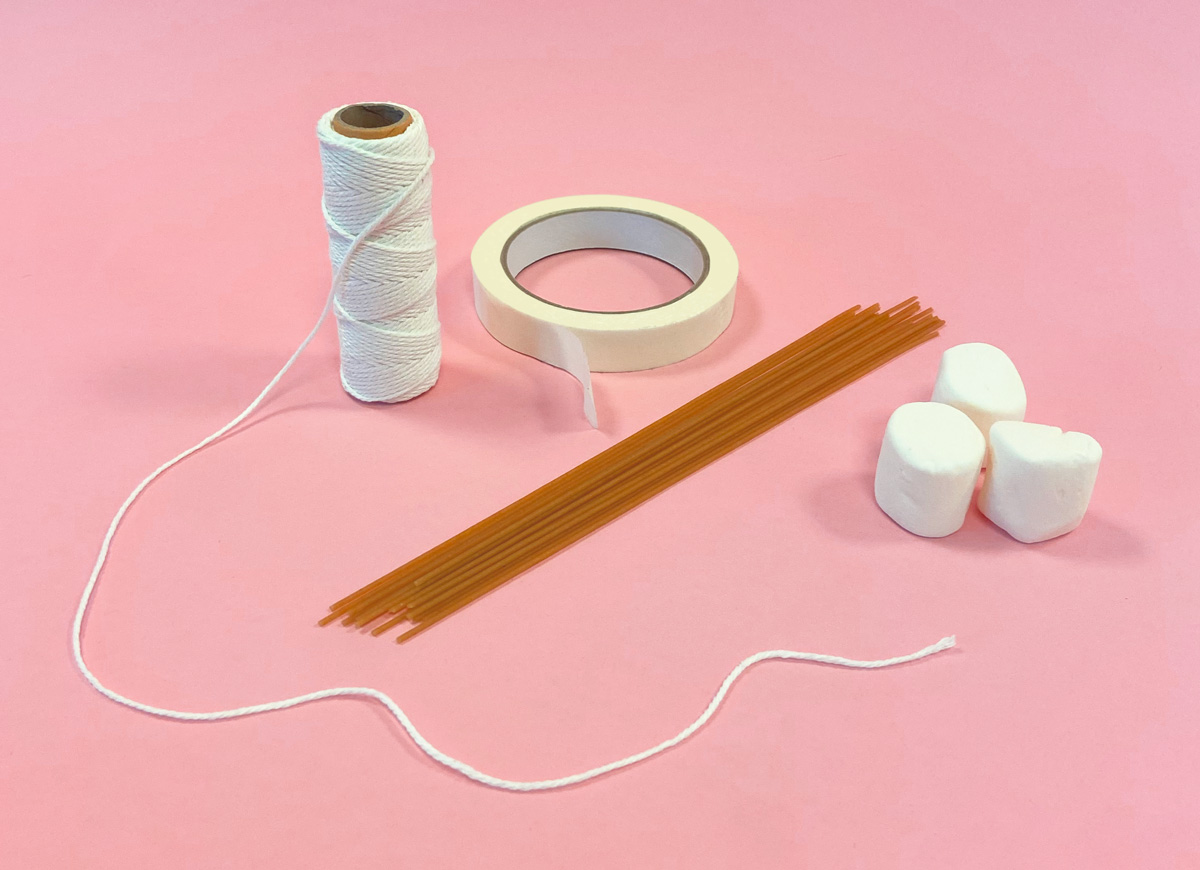
Each team needs the following materials:
- 1 Marshmallow
- 20 sticks of uncooked spaghetti (FYI: A typical box has enough sticks of spaghetti for 20 teams.)
- 1 yard of string
- 1 yard of masking tape
- Scissors
- A flat surface
- Timer
Steps:
- Break up into teams of 4–6 people.
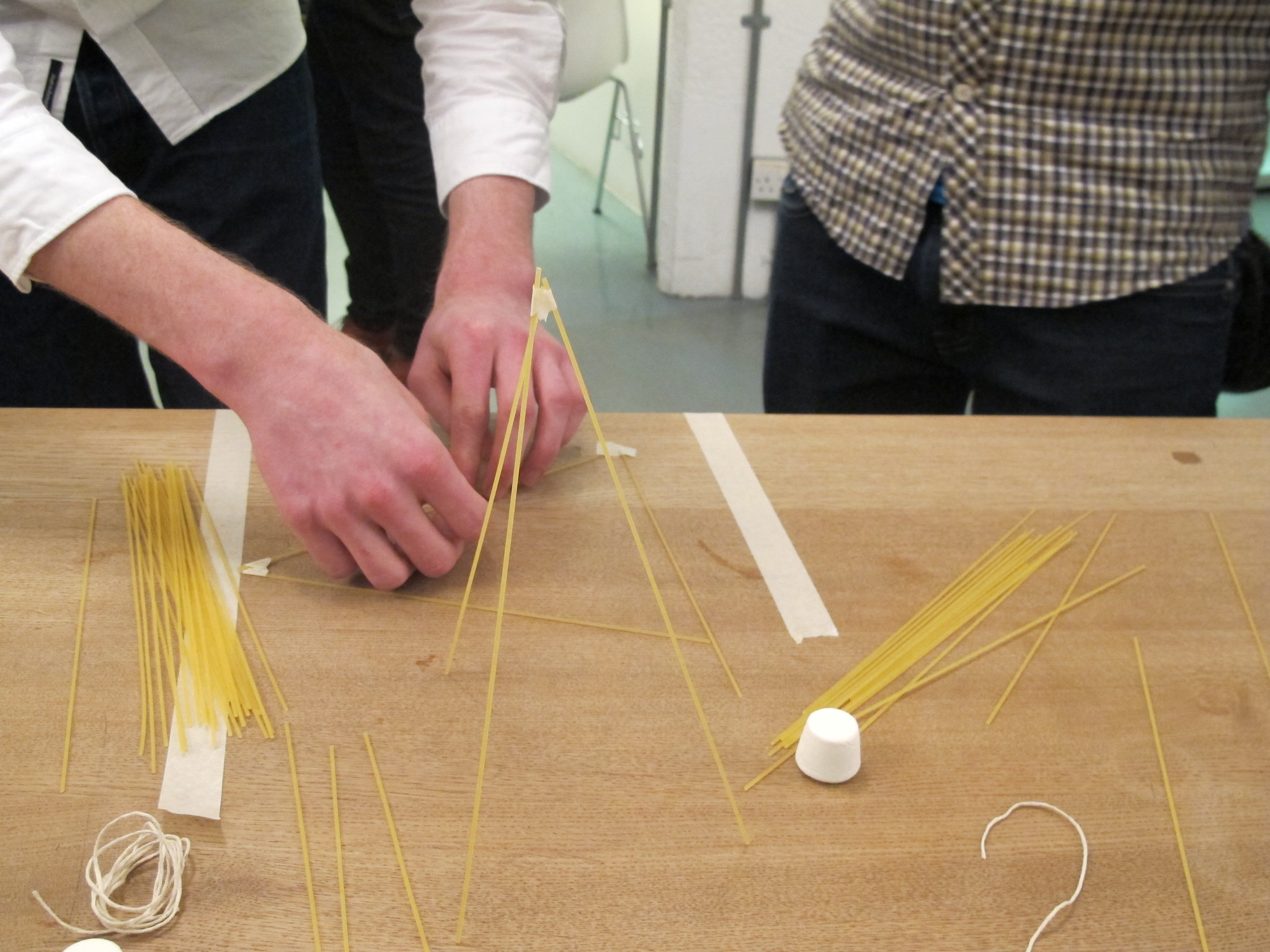
- Working as a team, build the highest free-standing structure possible with the marshmallow on top.
- There is no restriction on how much or how little of the materials teams use.
You can manipulate the materials however you want—break the spaghetti into pieces, cut the tape or string, etc. And you aren’t required to use all of the materials…except the marshmallow.
- The Challenge ends after 18 minutes.
No cheating! Your structure has to stand on its own. No propping it up or leaning it against a support.
- After 18 minutes, measure each structure from the table’s surface to the top of the marshmallow to determine the winning team.
- Talk through the challenge as a group. What obstacles did you face? Which strategies were most successful?
Hint: The key here is: Don’t be afraid to fail! The Marshmallow Challenge rewards teams willing to try out lots of different ideas over teams working towards just one single solution. Repeated attempts (and collapses) will teach you important lessons for how to improve your design.
For more information about the Marshmallow Challenge visit: marshmallowchallenge.com
Image source: IDEO.
This activity, which you’ll complete partly on your own, has you apply the innovation mindset to practices in your own daily life.
You’ll need the following materials:
- Paper
- Writing Utensil
Steps:
- Pair up and get ready to take notes.
- Interview your partner about their daily habits and routines.
For example, you can ask them about when they wake up, how they get dressed, how they get to school, how they tell time, how they carry their things, how they communicate with family and friends, how they eat breakfast/lunch/dinner, etc. - Based on that conversation, make a list of three prompts for your partner. The prompts should be ways your partner might change-up one of their routines, do something the “wrong” way or in a way that is unfamiliar to them. These should be changes that can be accomplished easily, but will allow your partner to have an unexpected experience. Use what you learned about them in your interview to make the prompts specific to their routines and lifestyles.
- Share this list of prompts with your partner and discuss. For example:
-
- They usually take time to choose their clothes for the day in the morning before school. What if they picked out an outfit the night before?
- They usually communicate with their closest friends via text. What if they called them instead?
- They usually tell time on their phone. What if they relied on other ways to know the time, like finding a clock or asking other people?
- Pick one of the prompts your partner made for you and try it before the next class.
- Document your experience changing up your routine in the form of a video, photographs, writing, collage or any medium of your choosing. Share your findings with your classmates. How did acting on your chosen prompt make you feel? Did you discover anything new about yourself, the people around you or your world?
Approaching familiar situations in new and unfamiliar ways is a terrific way to open your mind to the innovative design process!
How did it go? Submit your feedback.